
ChatGPT seems to be everywhere these days. Some business owners are using it to write social media posts, brainstorm marketing ideas, and create website content. Others are still trying to figure out what it is and whether it's worth the hype.
As AI continues to change the way people search for information and interact online, understanding the basics is becoming an important business skill. Below are answers to 10 of the most common questions we hear about ChatGPT, including how it works, what it can do, and how businesses can use it to save time and work smarter.
Q: Is the paid version of ChatGPT really worth the price?
While the free version of ChatGPT is a great place to start, the paid version unlocks more powerful tools that can save time and improve results for business owners and marketers.
Benefits of ChatGPT Plus:
Access to the newest and most capable AI models
Faster response times, even during peak hours
Better writing, editing, and content creation capabilities
Ability to analyze files, spreadsheets, PDFs, and images
Create custom GPTs tailored to your business
More advanced research and problem-solving tools, and more.
For many small businesses, the $20 monthly subscription for ChatGPT Plus quickly pays for itself in time savings alone.
Q: Can I trademark or copyright a logo design created with ChatGPT?
A: It depends on the type of protection you're seeking:
Trademark (®): Generally, yes. If you use the logo to identify your business, products, or services, you may be able to trademark it—even if AI helped create it. The key is that the logo functions as a brand identifier and doesn't infringe on someone else's trademark.
Copyright (©): Currently, the U.S. Copyright Office says copyright protection requires human creativity and authorship. A logo generated entirely by AI may not qualify for copyright protection. However, if a human graphic designer or illustrator (like Tingalls) significantly modifies, refines, or creates portions of the final logo, those human-created elements may be eligible for copyright.
What's the difference?
A registered trademark protects your brand identity, including logos, business names, and slogans.
Copyright protects creative works such as books, photos, illustrations, and artwork.
For most businesses, trademark protection is typically more important than copyright protection for a logo. A trademark helps prevent competitors from using a confusingly similar logo or brand name in your industry.
Bottom Line: AI-generated logos may face challenges in obtaining copyright protection if little or no human creativity is involved. However, they may still be eligible for trademark protection if they function as a brand identifier and meet standard trademark requirements. We recommend consulting your attorney if you have additional questions.
Q: Do you think ChatGPT will replace marketing professionals, writers, designers, and website developers?
A: No, but it has changed our workflow. We think of ChatGPT as an incredibly fast intern. It helps generate ideas, draft content, summarize information, and saves time on repetitive tasks.
What it can't do is understand our client's businesses, their history, strategy, customers, brand voice, goals, and market the way we, as experienced professionals, can.
The best results happen when AI and humans work together. AI helps create a first draft. Professionals refine it, fact-check it, improve it, and turn it into something that truly connects with your audience.
Businesses and marketing professionals who learn to use AI effectively will gain an advantage. Businesses that combine AI along with professional expertise will gain an even bigger one.
Q: Can Google tell if my website content was written by AI?
A: Google focuses on content quality, not how it was created. If your content is helpful, accurate, and provides value to readers, it can perform well in search results whether it was written by a person, AI, or a combination of both. The key is reviewing, editing, and improving AI-generated content before publishing it.
Q: What information should I never enter into ChatGPT?
A: Avoid entering confidential, proprietary, or sensitive information such as passwords, financial records, customer data, trade secrets, or private employee information. Treat ChatGPT like you would any other online tool and be mindful about the information you share.
Q: Why does ChatGPT sometimes give incorrect answers?
A: ChatGPT predicts the most likely answer based on patterns in data—it doesn't "know" facts the way a human expert does. While it can be incredibly helpful, it can also make mistakes, misunderstand questions, or provide outdated information. Always fact-check important information before using it in your business.
Q: How do I write better prompts?
A: The more information you provide, the better the results. Instead of saying, "Write a social media post," try something like, "Act like a social media strategist and write a friendly Facebook post for small business owners about the importance of updating their website design. Keep it under 150 words and include a call to action."
Think of ChatGPT as a new employee—the more context you give it, the better it can help.
Q: Can ChatGPT help with website Search Engine Optimization (SEO)?
A: Absolutely. ChatGPT can help brainstorm keywords, write title tags and meta descriptions, create FAQ content, generate blog ideas, and improve website copy.
However, it's only as good as the information you provide. The best SEO results still come from combining AI with a solid keyword strategy and human expertise.
Q: Can ChatGPT help me create social media content?
A: Absolutely. One blog article can become a month's worth of social media posts with the right prompts. ChatGPT can help you create captions, post ideas, polls, FAQs, customer success stories, video scripts, and more. Think of it as a content assistant that helps you get started faster—while you add the personal touch that makes your business stand out.
Q: Will ChatGPT replace Google?
A: Not entirely, but it's changing how people search for information. More consumers are turning to AI tools like ChatGPT for recommendations, research, and answers to questions. That's why businesses need to think beyond traditional SEO and start creating helpful, keyword-rich content that can be found by both search engines and AI tools.
BONUS — Q: Where does ChatGPT get its data?
A: ChatGPT doesn't search a database for answers the way Google searches the web. Instead, it was trained on a massive amount of text from books, articles, websites, and other publicly available information. When you ask a question, it predicts the most likely response based on patterns it learned during training.
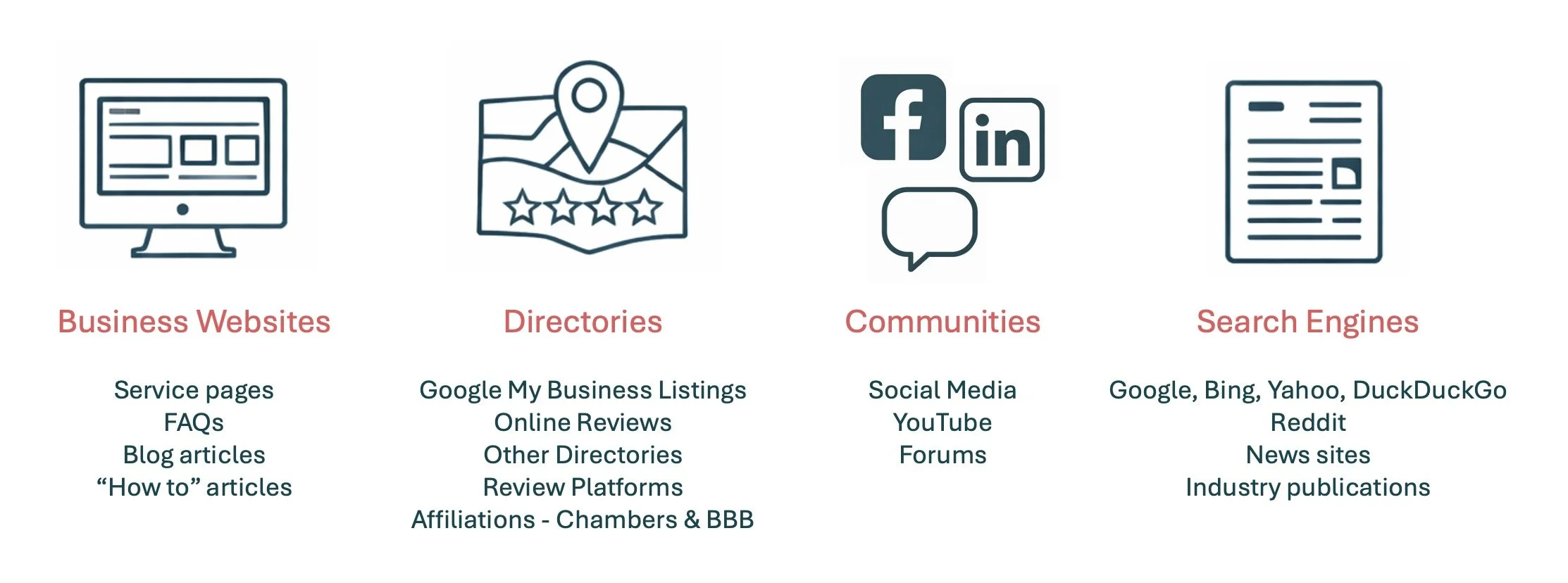
This is why it’s so important to include helpful, detailed FAQs, blogs, and service pages on your website, as well as to create consistent directory listings across the web.
Wanna Learn More?
Join us for a webinar!
In this free Zoom seminar, Tara Ingalls, owner of Tingalls Graphic Design, will walk attendees through the basics of content-based search engine optimization (SEO) and how to leverage ChatGPT to enhance your website with helpful, thoughtful content.
What You’ll Learn
What SEO is — and what it isn’t — including common myths and realistic expectations
6 key areas to add keywords on your website
How online search has changed with the rise of AI and tools like ChatGPT
How to write detailed and effective ChatGPT prompts to get responses you can use to generate content such as service website pages, blogs, and social media posts
5 Tips to help increase your business visibility in 30 days
Who Should Attend
Business owners who want to improve their company's visibility online
Employees responsible for managing their organization's website and social media
Marketing professionals looking to learn the basics of content-based SEO
